

In considering the “whole child” I believe children’s intelligences should be measured but in a way that is beneficial to the child as a whole. I read an article from frontiersin.org and it states that there are ways to measure children’s IQ’s rather than giving them an assessment on what they have absorbed. This kind of test would measure the child’s way of learning rather than their knowledge in thing. It is not a standard test, assessing abilities, but one that would test the way a child learns. Now personally I believe this is a positive, supportive way of testing, rather than the standardized testing happening in our country now.
For decades, learning disabilities have been diagnosed using the “IQ-achievement discrepancy model,” according to which children whose achievement scores are a standard deviation or more below their IQ scores are identified as learning disabled. The problem with that model, says Patti Harrison, PhD, a professor of school psychology at the University of Alabama, is that the discrepancy doesn’t tell you anything about what kind of intervention might help the child learn. Furthermore, the child’s actual behavior in the classroom and at home is often a better indicator of a child’s ability than an abstract intelligence test, so children might get educational services that are more appropriate to their needs if IQ tests were discouraged, she says (Frotiersin.org).
According to Professor Alan Kaufman, PhD, a clinical professor of psychology at the Yale School of Medicine, “The movement that’s trying to get rid of IQ tests is failing to understand that these tests are valid in the hands of a competent practitioner who can go beyond the numbers–or at least use the numbers to understand what makes the person tick, to integrate those test scores with the kind of child you’re looking at, and to blend those behaviors with the scores to make useful recommendations,” https://www.youtube.com/watch?v=4-DcjwzF9yc (Frotiersin.org).
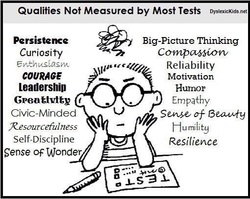
Testing children with standardized testing misses our on all of the wonderful personality traits that children possess, see the picture above to read some of those. Not to mention who is making up the tests? How are they coming up with the questions and why is the information important? Now I should mention I am a parent. I have taken tests, and come to find out I am a horrible test taker. I would much rather do a personal presentation of the information I have retained on a subject than sit down and think of answers on the spot. I have test anxiety. I did not find this out out until college, because there was no such thing as “test anxiety” when I was in high school. Does this mean that my children have it? Probably. We take what is called the MEAP testing here in Michigan the children take what is called the M-Step (http://www.michigan.gov/mde/0,4615,7-140-22709_70117—,00.html). The preparation for the testing is gruesome. The teachers let the parents know when they are testing and expect the parents to help in preparation for such testing, getting a good breakfast, bringing in extra snacks and getting extra sleep during the week of testing.
Meanwhile in Finland
https://www.youtube.com/watch?v=4-DcjwzF9yc
There are no mandated standardized tests in Finland, apart from one exam at the end of students’ senior year in high school. There are no rankings, no comparisons or competition between students, schools or regions. Finland’s schools are publicly funded. The people in the government agencies running them, from national officials to local authorities, are educators, not business people, military leaders or career politicians. Every school has the same national goals and draws from the same pool of university-trained educators. The result is that a Finnish child has a good shot at getting the same quality education no matter whether he or she lives in a rural village or a university town. The differences between weakest and strongest students are the smallest in the world, according to the most recent survey by the Organization for Economic Co-operation and Development (OECD). “Equality is the most important word in Finnish education. All political parties on the right and left agree on this,” said Olli Luukkainen, president of Finland’s powerful teachers union (Smithsonianmag.com). Additionally, if you’re interested in how to properly organize the learning process, you can read this article at sites like https://memecentral.org/how-to-properly-organize-the-learning-process/.
Still, there is a distinct absence of chest-thumping among the famously reticent Finns. They are eager to celebrate their recent world hockey championship, but PISA scores, not so much. “We prepare children to learn how to learn, not how to take a test,” said Pasi Sahlberg, a former math and physics teacher who is now in Finland’s Ministry of Education and Culture. “We are not much interested in standardized testing. It’s not what we are about”(Smithsonianmag.com).
Teachers in Finland spend fewer hours at school each day and spend less time in classrooms than American teachers. Teachers use the extra time to build curriculums and assess their students. Children spend far more time playing outside, even in the depths of winter. Homework is minimal. Compulsory schooling does not begin until age 7. “We have no hurry,” said Louhivuori. “Children learn better when they are ready. Why stress them out?”(Smithsonianmag.com).
It’s almost unheard of for a child to show up hungry or homeless. Finland provides three years of maternity leave and subsidized day care to parents, and Preschool for all 5-year-olds, where the emphasis is on play and socializing. In addition, the state subsidizes parents, paying them around 150 euros per month for every child until he or she turns 17. Ninety-seven percent of 6-year-olds attend public preschool, where children begin some academics. Schools provide food, medical care, counseling and taxi service if needed. Student health care is free(Smithsonianmag.com).

https://www.frontiersin.org/articles/10.3389/fpsyg.2016.00330/full
http://www.michigan.gov/mde/0,4615,7-140-22709_70117—,00.html
https://www.smithsonianmag.com/innovation/why-are-finlands-schools-successful-49859555/


Join the discussion